
Reading anyone?
Wow, how times have changed. When Dr. Montessori started her first “casa” over 100 years ago it was NOT expected that children would learn how to read or write. This is one of the many things that just “happened” in the Montessori classroom which amazed the world.
Now, children ARE in fact expected to learn to read and write at a very early age. In the US a huge emphasis has been placed on literacy. In our local school children are expected to read at least a full grade level above their current grade.
Children in a Montessori classroom are well equipped to learn to read in a natural way, by this I mean that they are not “drilled” with letters or words. They are simply given the opportunity to learn sounds and then have their own desire to read and write. The Montessori curriculum hasn’t changed in over 100 years! This is simply amazing. Children all over the world learn to read and write with the same materials in the casa.
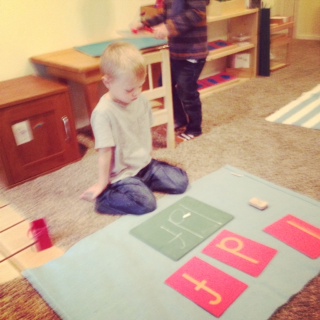
So lets get to the “magic”. We start by giving lessons with the sandpaper letters. We show 3 letters at a time, teaching the SOUND of the letter, NOT the name (this comes later). It has always amazed me that children seem to somehow learn the NAMES of the letters (and always in capital). This is valuable information, however, it does not aid reading. Try and sounds out a word saying the names of letters. It is impossible We have to know the SOUND the letters make.

When the child knows many sounds they are introduced to the moveable alphabet, a box containing cut out letters where a child can place an object on the rug and “spell it” by placing sounds that they hear. This is early writing. This material is used for a long time, to write lists at first, later sentences and stories. At first we are not worried about spelling, we just want the child to love the process of writing. Later we can use this material to correct spelling and teach punctuation. It is much easier to manipulate cut out letters then erase pencil on paper. Once the child is ready to write we can copy what has been written with the moveable alphabet.

Reading begins with a lesson where 10 objects are placed on the table and the child is told, “I am thinking of something but I am not going to tell you what it is. I am just going to write down the sounds.” The guide then starts to write on small slips of paper and the child begins to sounds out words, looking for a matching object. Soon the child is reading! This lessons not only gives the child experience with sounding words out but also shows them that reading is actually a way to communicate… silently. It is all very exciting!

Soon your child is reading everything they see; signs, boxes at the grocery store, menus.
If you are eager to teach your child at home, you can start by teaching each letter sound. This will allow your child to eventually read. This is usually a long process and many times children are proficient at “writing” before reading.


Really love these posts, Ginger!
Christina… Thank you! It’s so fun to share about Montessori
So glad you like them!